Selecting the Correct Statutory Document for Your Commercial Supplies
Under the Goods and Services Tax framework in India, business owners cannot simply issue arbitrary commercial receipts or generic billing memos. The law strictly regulates the specific documentary instrument that a registered supplier must issue based on the nature of the goods supplied and the tax registration status of the enterprise. The two primary outward supply documents recognized under the CGST Act are the Tax Invoice and the Bill of Supply.
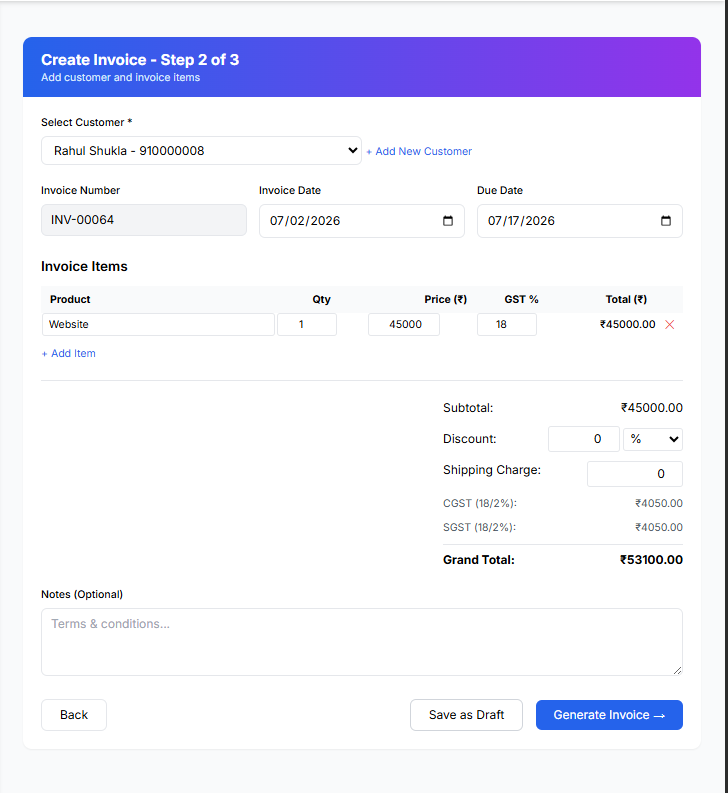
Issuing a Tax Invoice when legally required to issue a Bill of Supply—or vice versa—constitutes a serious statutory violation that attracts departmental penalties under Section 122. Utilizing our versatile GST invoice generator ensures business operators format and issue the exact statutory document mandated by law.
Statutory Guidelines: Section 31(1) vs Section 31(3)(c)
Under Section 31(1) of the CGST Act, a Tax Invoice must be issued by a registered taxpayer making taxable supplies of goods or services under the regular GST scheme. A tax invoice explicitly itemizes the taxable base value, specifies the exact rate of tax (5%, 12%, 18%, or 28%), segregates CGST, SGST, or IGST, and allows eligible registered buyers to claim Input Tax Credit under Section 16.
Conversely, under Section 31(3)(c) read with Rule 49, a registered person is legally prohibited from issuing a tax invoice and must issue a "Bill of Supply" in two specific commercial situations: when supplying strictly exempted goods or services; or when the taxpayer has opted into the Composition Scheme under Section 10. A Bill of Supply cannot display any tax charge.
| Statutory Dimension | Tax Invoice (Section 31 / Rule 46) | Bill of Supply (Section 31 / Rule 49) | Compliance Impact |
|---|---|---|---|
| Eligible Issuer | Regular GST registered taxpayers | Composition dealers & exempt goods suppliers | Wrong issuer triggers Section 122 penalties |
| Tax Charging Legality | Mandatory to calculate & display GST | Strictly illegal to charge or collect tax | Charging tax on Bill of Supply is unlawful |
| Input Tax Credit (ITC) | 100% eligible for recipient ITC claims | Completely ineligible for ITC pass-through | Corporate buyers require tax invoices for credit |
| Header Endorsement | Must state "Tax Invoice" prominently | Must state "Composition person..." or exempt | Header validates legal document status |
Practical Protocol for Choosing Between Documents
To determine the correct document, evaluate your tax registration. If you are enrolled under the 1% Composition Scheme, open our online invoice generator, select the "Bill of Supply" template, and ensure the mandatory endorsement clause is enabled.
If you operate under the Regular Scheme and supply taxable goods, select the "Tax Invoice" template. If you sell both taxable and exempt items in a single consignment, Rule 46A permits issuing a combined "Invoice-cum-Bill of Supply".
Critical Traps in Bill of Supply Issuance
A severe violation penalized by tax authorities is composition taxpayers collecting GST from customers on a Bill of Supply. Composition dealers must absorb tax liabilities internally at flat rates without collecting tax from buyers.
Statutory Issuance Conditions and ITC Pass-Through Restrictions
The legal distinction between a Tax Invoice (Section 31) and a Bill of Supply (Section 31(3)(c)) is absolute under GST law. A Tax Invoice is issued exclusively by regular GST-registered entities supplying taxable goods or services; it itemizes tax rates and enables registered buyers to claim Input Tax Credit.
Conversely, a Bill of Supply must be issued when supplying wholly exempt goods or services, or by composition taxpayers registered under Section 10. Issuing a Tax Invoice with tax charged when legally required to issue a Bill of Supply violates Section 122 and triggers mandatory deposit of tax collected plus equal penalties.
Frequently Asked Questions
Can a regular registered taxpayer issue a Bill of Supply?
Yes, a regular registered taxpayer must issue a Bill of Supply when supplying wholly exempt goods (such as fresh fruits or unbranded food grains) where zero GST applies.
Is consecutive serial numbering required for Bills of Supply?
Yes, Rule 49 mandates that Bills of Supply must maintain unique consecutive serial numbering not exceeding 16 characters for each financial year.
Can a business issue a Bill of Supply for export transactions?
Export transactions under Letter of Undertaking (LUT) require a specialized commercial export tax invoice rather than a Bill of Supply.
Can a single document combine both taxable and exempt supplies?
Yes, under Rule 46A, a registered person supplying both taxable and exempt goods or services to an unregistered person can issue a consolidated "Invoice-cum-Bill of Supply".
Choosing the appropriate document maintains pristine tax records and protects your commercial credibility. Create compliant tax invoices and bills of supply today with Billbr Invoicing Tools.
By deploying specialized cloud billing infrastructure for tax invoice vs bill of supply: which one should your business issue under gst?, Indian commercial enterprises, consultants, healthcare providers, and retailers systematically eliminate manual calculation blunders,.
Falcon HQ
falcon.hq@gmail.com