Inverting the Traditional Flow of Indirect Tax Liability
In the standard operating framework of the Goods and Services Tax, the legal supplier of goods or services collects tax from the buyer and deposits the proceeds with the government. However, under specific statutory circumstances established by the GST Council, this conventional tax remittance mechanism is completely inverted. Under the Reverse Charge Mechanism (RCM), the statutory liability to remit GST to the government transfers entirely to the registered commercial recipient.
Failing to identify RCM supplies or neglecting to pay reverse charge liabilities in cash results in severe tax demands, compounding interest, and penalties under Section 73. Utilizing our verified GST invoice generator allows business buyers to identify reverse charge triggers and prepare legally compliant self-invoices.
Statutory Architecture: Section 9(3) and Section 9(4)
Under Section 9(3) of the CGST Act, the government has notified specific categories of goods and services subject to mandatory reverse charge. These include services provided by Goods Transport Agencies (GTA), legal representation services rendered by individual advocates or senior counsels, director remuneration paid by corporate boards, sponsorship services, and copyright transfers by authors and music composers.
Furthermore, under Section 31(3)(f), when a registered recipient procures taxable goods or services subject to reverse charge from an unregistered supplier, the recipient must mandatorily issue a "Self-Invoice" on the date of receipt. In addition, Section 31(3)(g) dictates that a "Payment Voucher" must be issued at the time of paying the supplier.
| RCM Supply Category | Statutory Basis | Applicable GST Rate | Recipient Invoicing Obligation |
|---|---|---|---|
| Goods Transport Agency (GTA) | Notification 13/2017 (5% rate) | 5% GST (paid in cash via RCM) | Consignment note + Recipient RCM liability |
| Advocate & Legal Services | Notification 13/2017 item 2 | 18% GST (paid in cash via RCM) | Issue Self-Invoice & Payment Voucher |
| Director Remuneration | Notification 13/2017 item 6 | 18% GST (paid in cash via RCM) | Corporate entity pays RCM in cash |
| Unregistered Vendor Supplies | Section 9(4) specified real estate | 18% or 28% GST per commodity | Mandatory Self-Invoice under Rule 46 |
Step-by-Step Procedure to Manage RCM Compliance
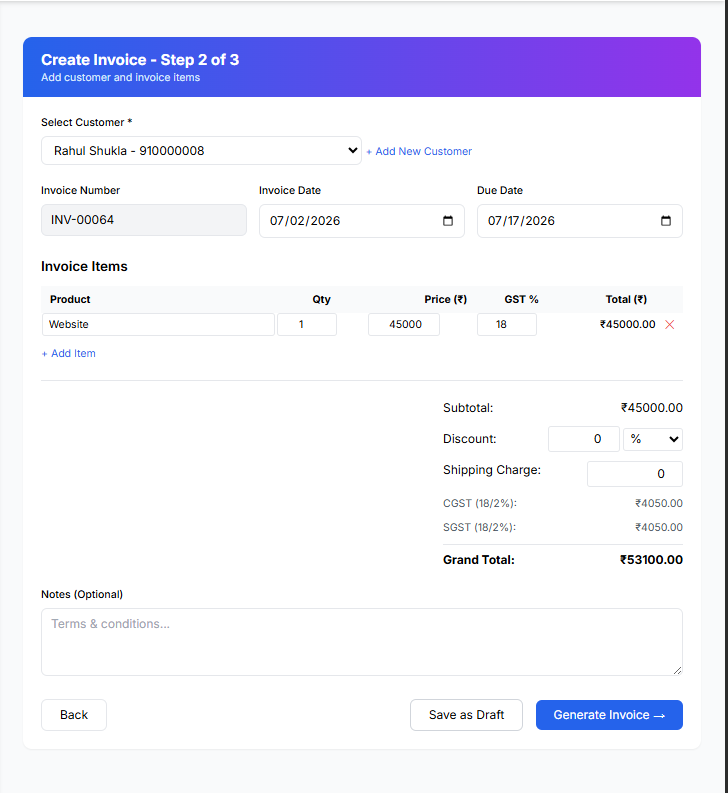
When procuring notified RCM services, open our GST invoice generator, select the "Self-Invoice / RCM" template, and enter your business credentials as the recipient. Enter supplier details and enable the "Tax Payable on Reverse Charge: YES" indicator.
Calculate the applicable tax. Crucially, under Section 49(4), RCM liabilities cannot be settled using available Input Tax Credit balances; they must be deposited in cash via the electronic cash ledger. Once remitted, the business can claim 100 percent Input Tax Credit on the same RCM amount in the same monthly GSTR-3B return.
Critical Pitfalls in Reverse Charge Accounting
A frequent compliance violation is attempting to offset RCM output tax liabilities using accumulated electronic credit ledger balances. Tax authorities routinely disallow such credit settlements, demanding cash remittance with 18 percent interest.
Electronic Cash Ledger Settlement and Self-Invoice Retention
A critical compliance mandate under the Reverse Charge Mechanism is that tax liability cannot be discharged using accumulated Input Tax Credit balances. Under Section 49(4), RCM liabilities must be paid exclusively in cash through the Electronic Cash Ledger. However, once paid in cash, the recipient is legally entitled to claim an equivalent Input Tax Credit in the same tax period.
Furthermore, when procuring RCM services (such as advocate fees, goods transport agency services, or director remuneration) from unregistered entities, Section 31(3)(f) dictates that the recipient must issue a self-invoice. Preserving copies of self-invoices and corresponding payment vouchers protects corporate entities during statutory financial audits and GST departmental scrutiny.
Frequently Asked Questions
Can a recipient claim Input Tax Credit on tax paid under RCM?
Yes, once tax liability under reverse charge is remitted in cash, the recipient is fully entitled to claim Input Tax Credit under Section 16, subject to general eligibility rules.
Does an unregistered person have to pay GST under reverse charge?
No, reverse charge obligations apply strictly to registered commercial taxpayers; unregistered end consumers are not subject to RCM remittance duties.
What is the time limit for issuing a self-invoice under Section 31(3)(f)?
A self-invoice must be issued on the date of receipt of goods or services from the unregistered supplier, maintaining sequential serial numbering for that fiscal year.
Is RCM applicable on director remuneration paid to whole-time directors?
Remuneration paid to independent or non-executive directors is subject to 18 percent RCM under Notification 13/2017. However, salary paid to whole-time directors subject to TDS under Section 192 represents an employee-employer relationship and is exempt from GST.
Mastering reverse charge mechanics protects your enterprise from unexpected tax recovery notices and cash flow disruption. Manage RCM self-invoices effortlessly using Billbr GST Invoicing Tools.
By deploying specialized cloud billing infrastructure for reverse charge mechanism (rcm) invoicing: when buyer must pay gst to government, Indian commercial enterprises, consultants, healthcare providers, and.
Falcon HQ
falcon.hq@gmail.com