Strategic Tax Structure Selection for Indian Retail Merchants
When launching or registering a retail enterprise under the Goods and Services Tax framework in India, business owners face a critical structural decision: whether to enroll under the simplified Composition Scheme under Section 10 or register as a Regular Taxpayer. Choosing the incorrect tax structure can severely restrict your commercial customer base, inflate procurement costs, or create unnecessary administrative compliance expenses.
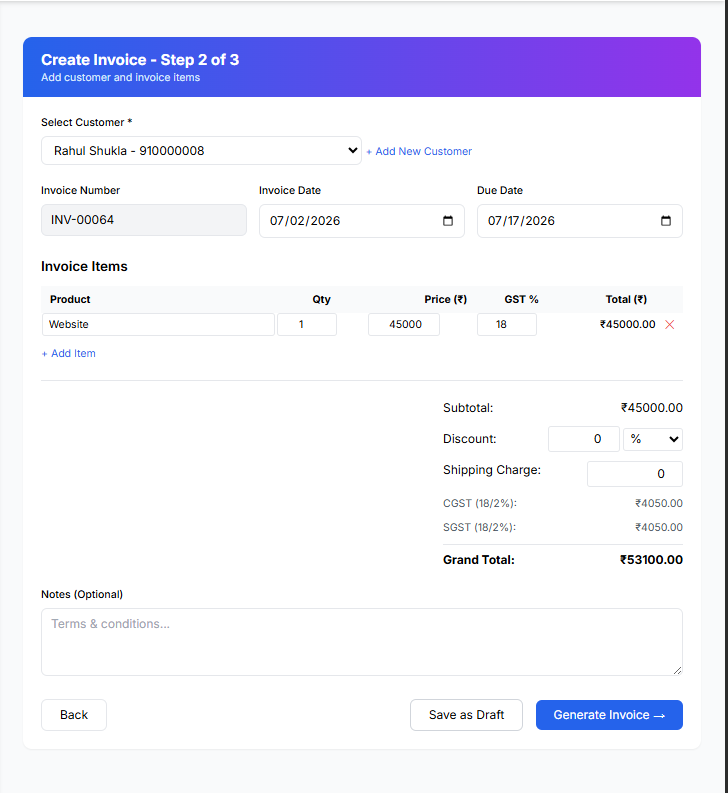
Each scheme is engineered to serve fundamentally different commercial operating models. Understanding the trade-offs regarding Input Tax Credit eligibility, customer tax invoicing, and interstate sales restrictions is essential. Using an agile platform like the Free GST invoice generator guarantees seamless compliance regardless of your chosen tax scheme.
Core Regulatory Provisions: Section 10 Composition Framework
Under Section 10 of the CGST Act, eligible retail traders and manufacturers with an aggregate annual turnover of up to one and a half crore rupees (seventy-five lakh rupees for special category northeastern states) can opt into the Composition Scheme. Eligible retailers pay a nominal flat tax rate of 1 percent on total turnover (0.5% CGST plus 0.5% SGST) and file simplified quarterly return statements (CMP-08).
However, this administrative simplicity carries major commercial restrictions. Composition dealers cannot make interstate outward supplies, cannot sell through e-commerce operator platforms, cannot claim Input Tax Credit on goods purchased for resale, and are strictly prohibited from collecting GST from customers on their sales bills.
| Comparison Parameter | Composition Scheme (Section 10) | Regular GST Scheme | Retail Business Impact |
|---|---|---|---|
| Statutory Tax Rate | 1% flat on total sales turnover | Standard rate slabs (5%, 12%, 18%, 28%) | Composition minimizes direct tax calculation overhead |
| Input Tax Credit (ITC) | Completely blocked on purchases | Full ITC claimable on stock & expenses | Regular scheme prevents procurement tax cascading |
| Customer Invoicing Document | Mandatory "Bill of Supply" (no tax added) | Standard "Tax Invoice" showing tax breakup | B2B enterprise buyers will not buy from Composition |
| Return Filing Frequency | Quarterly statement (CMP-08) + GSTR-4 | Monthly GSTR-1 and GSTR-3B filings | Composition slashes accounting and CA retainers |
Choosing the Right Structure for Your Retail Business Model
To determine the optimal scheme, analyze your target customer demographics. If your shop primarily serves neighborhood retail end-consumers who do not require Input Tax Credit, and you purchase from local distributors, the Composition Scheme provides significant operational peace of mind. You issue simple bills using our online invoice generator under "Bill of Supply" format.
Conversely, if you sell goods to corporate clients, government institutions, or plan to expand into interstate e-commerce trade, registering under the Regular Scheme is mandatory. You can issue itemized tax invoices with full credit pass-through using our sales invoice generator.
Compliance Traps for Composition Dealers
A severe violation is charging GST to customers on a bill issued by a composition taxpayer. Section 10 strictly forbids collecting tax from purchasers; any composition dealer found charging GST faces immediate cancellation of composition status and retrospective penalty assessments.
Margin Viability and Inter-State Trading Constraints
Choosing between the Composition Scheme under Section 10 and the Regular GST regime is a critical strategic decision for small retailers. Composition dealers enjoy simplified quarterly tax returns (Form CMP-08) and pay a nominal flat tax of 1 percent on turnover, but they are legally prohibited from collecting GST from customers or claiming Input Tax Credit on inventory purchases.
Additionally, composition taxpayers cannot execute inter-state outward sales or sell merchandise via e-commerce marketplaces. If your retail business procures inventory heavily from GST-registered distributors and serves B2B commercial buyers needing tax invoices, opting for the Regular GST regime maximizes profit margins through unhindered ITC pass-through.
Frequently Asked Questions
Can a composition retailer switch to the regular scheme mid-year?
Yes, a taxpayer can opt out of the composition scheme voluntarily at any time during the financial year by filing Form GST CMP-04 on the common portal.
Can a composition dealer issue a tax invoice for commercial transactions?
No, composition taxpayers are legally prohibited from issuing tax invoices; they must exclusively issue a "Bill of Supply" displaying the words "Composition taxable person, not eligible to collect tax on supplies".
Are composition dealers subject to reverse charge mechanism (RCM)?
Yes, composition taxpayers must pay GST under reverse charge at standard applicable rates when procuring specified goods or services covered under Section 9(3) or 9(4).
Can a retailer switch from Composition to Regular GST during the fiscal year?
A taxpayer can exit the Composition Scheme voluntarily at any time during the financial year by filing Form GST CMP-04 on the portal, transitioning immediately to regular tax invoicing and ITC availment.
Aligning your GST tax registration with your retail commercial strategy protects profit margins and accelerates business expansion. Experience versatile invoicing for both composition and regular schemes with Billbr Billing Solutions.
Falcon HQ
falcon.hq@gmail.com