Deciphering the Taxation of Commercial Bundles and Packages
In contemporary commercial trade, businesses rarely sell products or services in absolute isolation. Retailers bundle television sets with transport insurance and installation services; hotels provide luxury room accommodation bundled with complimentary buffet breakfasts; and gift hampers combine dry fruits, chocolates, canned beverages, and decorative confectionery into a single festive package. When multiple goods or services are packaged together for a single consolidated price, applying GST rates becomes complex.
Misclassifying a bundled transaction under Section 8 of the CGST Act can lead to catastrophic tax penalties and differential tax demands. Utilizing our verified GST invoice generator ensures commercial enterprises classify bundled supplies accurately and format transparent tax invoices.
Statutory Architecture: Section 2(30), Section 2(74) and Section 8
Under Section 2(30) of the CGST Act, a "Composite Supply" consists of two or more taxable supplies of goods or services (or both) naturally bundled and supplied in conjunction with each other in the ordinary course of business, one of which is a "Principal Supply". Under Section 8(a), a composite supply is treated as a supply of such principal supply, and the GST rate of the principal supply applies to the entire bundled package.
Conversely, under Section 2(74), a "Mixed Supply" consists of two or more individual supplies of goods or services made together for a single price, which do not constitute a naturally bundled composite supply. Under Section 8(b), a mixed supply is legally treated as a supply of that particular item which attracts the highest rate of tax among all bundled components.
| Supply Classification | Statutory Definition | Tax Rate Benchmark | Practical Commercial Example |
|---|---|---|---|
| Composite Supply (Sec 8(a)) | Naturally bundled in ordinary trade | Rate of the Principal Supply applies to all | Air conditioner (28%) + transport/install (18%) = 28% |
| Mixed Supply (Sec 8(b)) | Artificially bundled for single price | Highest tax rate among all items applies | Gift basket of dry fruits (12%) & chocolates (28%) = 28% |
| Itemized Separate Billing | Individually priced on tax invoice | Each item taxed at its own specific rate | Separate line items for goods, freight & installation |
| Hotel with Breakfast | Naturally bundled hospitality service | Taxed at applicable hotel room GST slab | Complimentary breakfast taxed at room rate |
Step-by-Step Procedure to Structure Bundled Invoices
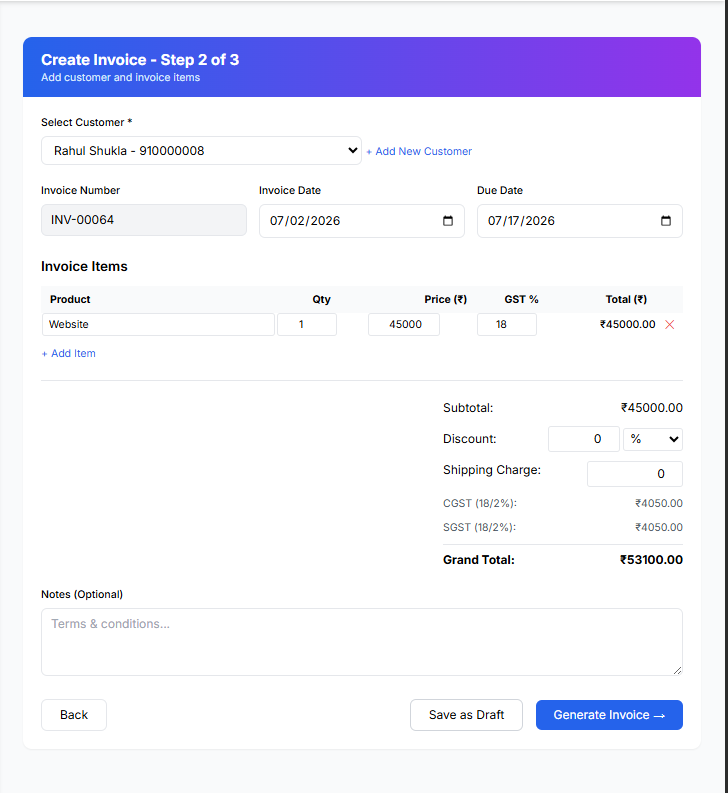
To compile an authenticated bundled bill, open our GST invoice generator. If your supply qualifies as a Composite Supply (such as machinery sales including freight and commissioning), declare the principal machine HSN code and apply its statutory tax rate across the combined package.
To eliminate tax ambiguity and protect profit margins on mixed bundles, avoid single lump-sum package pricing. Instead, itemize individual products on separate invoice rows using our sales invoice generator, allowing each commodity to be taxed at its legitimate statutory rate.
Critical Pitfalls in Commercial Bundling
A frequent commercial disaster is selling festive gift hampers at a single price containing a 28 percent luxury item alongside 5 percent food staples, while mistakenly applying the lower tax rate. Section 8(b) mandates that the entire hamper value is taxed at 28 percent.
Section 8 Tax Liability Bundling and Commercial Structuring
Determining whether bundled goods and services represent a Composite Supply or a Mixed Supply under Section 8 of the CGST Act is one of the most litigated areas of indirect taxation. A Composite Supply consists of two or more supplies naturally bundled in the ordinary course of business (e.g. goods packaged and transported with insurance), taxed at the rate of the principal supply.
In contrast, a Mixed Supply consists of two or more independent supplies bundled together for a single lumpsum price that can be supplied separately (e.g. a gift hamper containing dry fruits at 12%, chocolates at 18%, and aerated drinks at 28%). A mixed supply is taxed at the highest rate among the bundled items (28%). Clear invoice itemization avoids unexpected highest-slab tax assessments.
Frequently Asked Questions
How do tax authorities determine whether a bundle is "naturally bundled"?
Tax authorities evaluate standard trade practices, consumer perception, common commercial advertising, and whether elements can be realistically procured separately in normal trade.
Does charging separate line items for transport turn a composite supply into a mixed supply?
No, if goods are transported under CIF or delivered terms, the transport remains ancillary to the principal supply of goods, maintaining composite supply status.
Can a business claim Input Tax Credit on goods bundled in a mixed supply?
Yes, input tax credit is fully claimable on underlying inputs used to assemble mixed supplies, subject to standard Section 16 eligibility criteria.
How can a business avoid being taxed at the highest slab for bundled products?
By itemizing individual prices for each distinct product or service on the invoice rather than quoting a single lumpsum price, each item is taxed at its respective statutory GST rate.
Accurate commercial classification protects your business from contentious tax disputes and prevents margin erosion. Structure and issue compliant bundled invoices today with Billbr GST Invoicing Tools.
Falcon HQ
falcon.hq@gmail.com